



A custom six to ten page website costs $2,250 to $12,090 in design fees from an independent US designer, and $3,000 to $12,340 from a web design agency. A single landing page runs $675 to $3,510 from a freelancer. Those bands come from published hourly rates [1] [2] applied to modelled design hours for that scope. We set out below how those hours are derived.
Design fees are the smaller half of the story. On full website builds, GoodFirms found that design usually accounts for 10 to 20 percent of the budget, while development takes 50 to 70 percent [6]. So a quote that bundles both isn't comparable to a design fee until you separate the design line out.
Which is why this page is a placement tool rather than a price guide. The web design cost calculator below takes one specific number, the quote you gave or the one you received, asks you what it covers, and shows you where it sits inside the range for that scope.
A founder holding three quotes for the same website design brief, differing by 4x, wants to know which one is out of line. A designer about to send $3,200 for a six-page site wants to know whether that reads as confident or reckless. One range answers both.
How much does a website cost in 2026?
Design fees only, custom design, US-based provider, before anything beyond design is added.
| Scope | Independent freelancer | Web design agency |
|---|---|---|
| Landing page, 1 page | $675 to $3,510 (typical $1,540) | $900 to $3,580 (typical $1,800) |
| Small site, 2 to 5 pages | $1,500 to $8,000 (typical $3,460) | $2,000 to $8,160 (typical $4,040) |
| Business site, 6 to 10 pages | $2,250 to $12,090 (typical $5,220) | $3,000 to $12,340 (typical $6,080) |
| Larger site, 11 to 20 pages | $3,300 to $17,550 (typical $7,610) | $4,400 to $17,910 (typical $8,880) |
| Extensive site, 21+ pages | $4,800 to $25,540 (typical $11,070) | $6,400 to $26,070 (typical $12,920) |
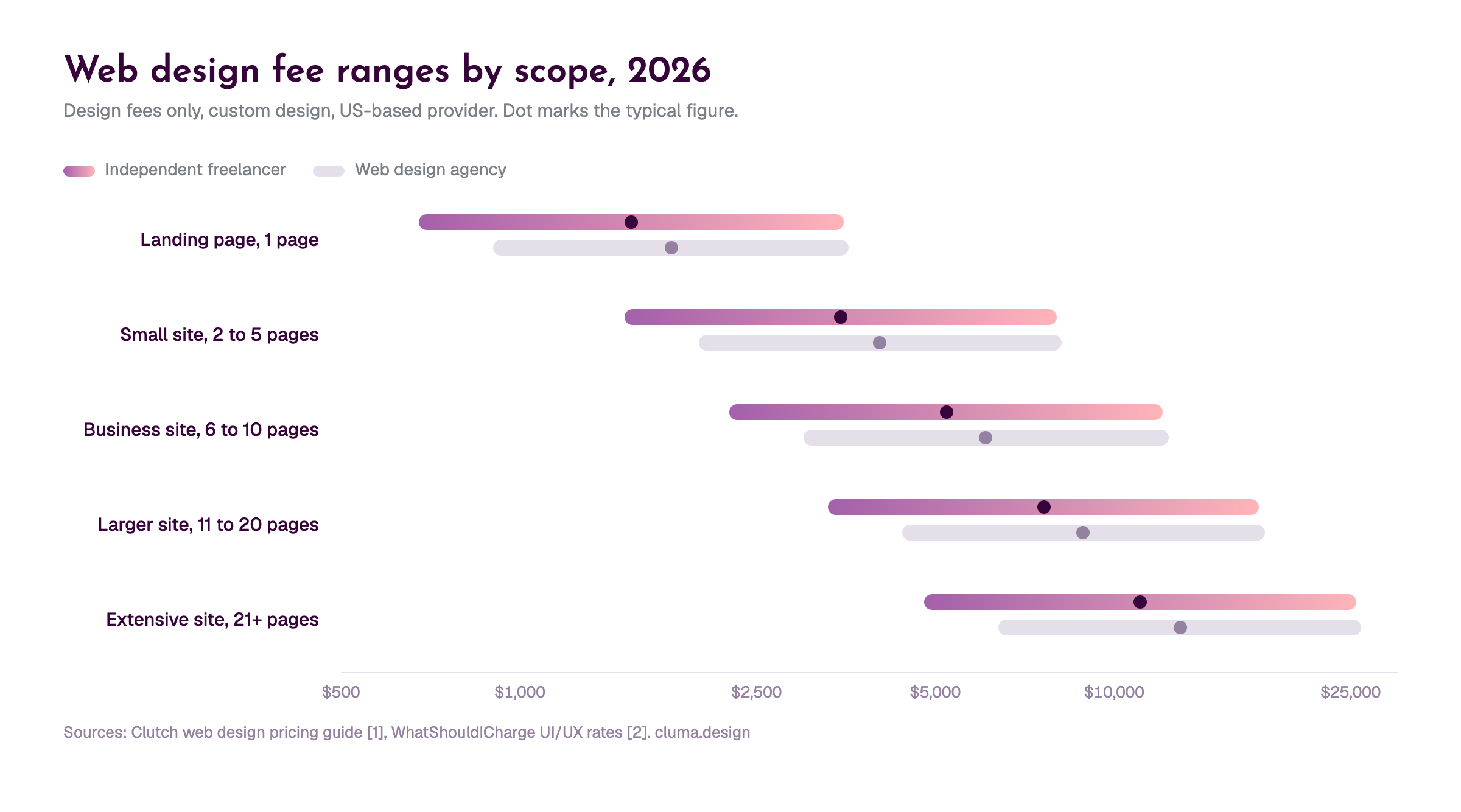
Two cheaper tiers sit below both columns. Template and site-builder work bills at $25 to $49 an hour on Clutch [1], putting a business site at $750 to $3,040. Marketplace freelancers sit lower still: Upwork publishes a $21 median for web designers with a typical range of $15 to $30 [3], or $450 to $1,860 for the same scope.
Marketplace medians are global transaction data weighted toward offshore supply, so they're answering a different question than a US agency rate does.
Location moves every figure above. Clutch groups its bands by country: $100 to $149 an hour in the United States and Australia, $50 to $99 in Canada, Poland and Spain, $25 to $49 in India, the Philippines and Ukraine [1]. Divide each band midpoint by the US midpoint of $124.50 and you get the multipliers the calculator uses: 1.0, then 0.6, then 0.3.
The web design cost calculator
Set the page count, then anything beyond design the quote includes, then who is doing the work and where. Enter the number last.
Open the web design cost calculator
Here's a worked example. A six to ten page custom site, copywriting included, from an independent US freelancer: 30 to 62 design hours at $75 to $195 gives $2,250 to $12,090, and copywriting at $60 to $300 across roughly eight pages adds $480 to $2,400.
The band becomes $2,730 to $14,490 with a typical figure of $6,290. Enter $3,200 against that and the calculator reads low end, $3,090 under typical.
How to read the result
What comes back is a distance. The calculator reports how far your number sits from the typical quote for that scope, and whether it reads as low end, mid range or high end.
Sitting high is its own kind of correct. Senior ownership, a design system and a brand that has to carry weight all belong at the top of a band, and a quote there is doing its job.
Sitting low is rarely the bargain it looks like. A number well under the range usually means something was left out, and whatever was left out tends to surface once the work starts.
All of it depends on setting the switches to the quote in front of you rather than the project you hoped to buy.
Why two quotes for the same brief differ by 4x
Two providers see the same brief. One comes back at $4,000, the other at $16,000, and your instinct is to call the second one greedy.
Look at what each one assumed and the gap usually closes. Template adaptation against custom design from a blank canvas. Client-supplied copy against a budgeted writer at $60 to $300 a page [4]. Design alone against design plus the build, where the design share drops to 10 to 20 percent of the total [6]. None of that is legible in the number, so the number is what gets compared.
The published data carries the same ambiguity, and it's worth seeing how far apart the definitions sit. Clutch keeps web design and web development in separate categories, so its hourly bands measure design [1]. WebFX counts SEO and ecommerce functionality as part of web design [4]. DesignRush reports the whole project budget, everything the client paid, under the same phrase [5]. Three sources, three different things being measured, one label on all of them.
So the calculator starts from design fees and turns every other assumption into a switch you set yourself. Once the assumptions match, the numbers become comparable, and that's the entire mechanism.
What is the average web design cost?
DesignRush puts the mean project at $46,000 and the median between $20,000 and $25,000, with two thirds of projects under $25,000 [5]. Clutch reports a mean of $38,105 while noting that most projects it reviews come in under $10,000 [1].
Clutch's mean runs close to four times its typical project. DesignRush's is double its median. Both gaps are the signature of a right-skewed distribution, where a handful of enterprise builds pulls the average upward and no ordinary project lives near it. So the calculator reports a low figure, a typical figure and a high figure instead of one average, and the typical figure is a geometric mean.
How the calculator works
We kept it simple enough to check by hand, which is the point. Every figure traces to one of the eight sources at the end of this article.
- The hours come from one external anchor. Source [2] publishes a design-only band of $1,500 to $8,000 for a simple website and, separately, an hourly band of $75 to $195. Dividing the first by the second gives 20 to 41 hours for a two to five page site. That's the only measured quantity in the hours model. Nothing else in this article feeds back into it.
- Other scopes scale by a stated rule. Hours grow as pages to the power 0.6, because layout systems, type scale and component decisions are made once and then reused. Each bucket is computed at a representative page count: 1, 4, 8, 15 and 28. So a landing page lands at 9 to 18 hours, a six to ten page site at 30 to 62, and the 21+ bucket, modelled at 28 pages, at 64 to 131. Disagree with the exponent or the representative counts and the whole model is yours to re-derive.
- Hourly rates come straight from the sources. Independent freelancer $75 to $195 [2], web design agency $100 to $199 [1], template or site builder $25 to $49 [1], marketplace freelancer $15 to $30 [3]. Clutch's modal band for shortlisted agencies is $100 to $149. Listings on the same page run up to $150 to $199, and the calculator uses the wider span as its 10th to 90th percentile.
- Regional multipliers are arithmetic on Clutch's bands. Band midpoint divided by the US midpoint of $124.50. We only offer the countries Clutch actually names, which is why the region list is short.
- Anything beyond design is a separate line. Copywriting $60 to $300 per page, SEO $2,000 to $10,000 and ecommerce functionality $5,000 to $25,000 come from the WebFX study [4]. Illustration [7] and imagery [8] rest on thinner sourcing, so read them as indicative.
- The spread is log-normal. Low is treated as the 10th percentile, high as the 90th. Cost data is right-skewed, as the mean-versus-median gap above demonstrates. The typical figure is the geometric mean of low and high, and that figure is what your quote is measured against.
Everything is in US dollars. Convert a euro or pound quote first: the bands shift little between currencies at 2026 rates, but the placement can.
Where the calculator breaks
The edges matter more than the centre, so here they are.
- Design fees only, with no development switch. No source in this set prices development against design-scoped work, so we left it out rather than invent a multiplier. If a quote bundles the build, ask for the design line separately and compare that.
- Custom design is assumed. Template work has its own row in the provider list. Pick it, or a template quote will read as underpriced against custom work.
- Enterprise work sits outside the model. Past roughly $150,000 the drivers are procurement, compliance and internal politics. That ceiling is our editorial judgement, not a finding, and no public dataset covers what lies above it.
- Two coefficients are assumptions, not measurements. Hours scale as pages to the power 0.6, and the illustration and imagery lines scale by page count over eight, clamped between half and triple. The 21+ bucket is computed at 28 pages. Change any of the three and the output moves.
- Wide bands are deliberate. A $75 freelancer and a $195 freelancer are both real, and hiding that behind a midpoint would make the output look more precise than the data is.
- Tiers aren't interchangeable. Upwork's $21 median and a $120 freelance median come from different instruments measuring different populations. The calculator keeps them apart and so should you.
- Two figures rest on thin sourcing. Illustration comes from a general consumer marketplace indexed as 2024, imagery from one photographer's published rate card in a single regional market. Neither is a market study, so treat both as indicative.


